
Safety Paperwork Isn’t Just a Headache. It’s a Six-Figure Liability Hiding in Plain Sight
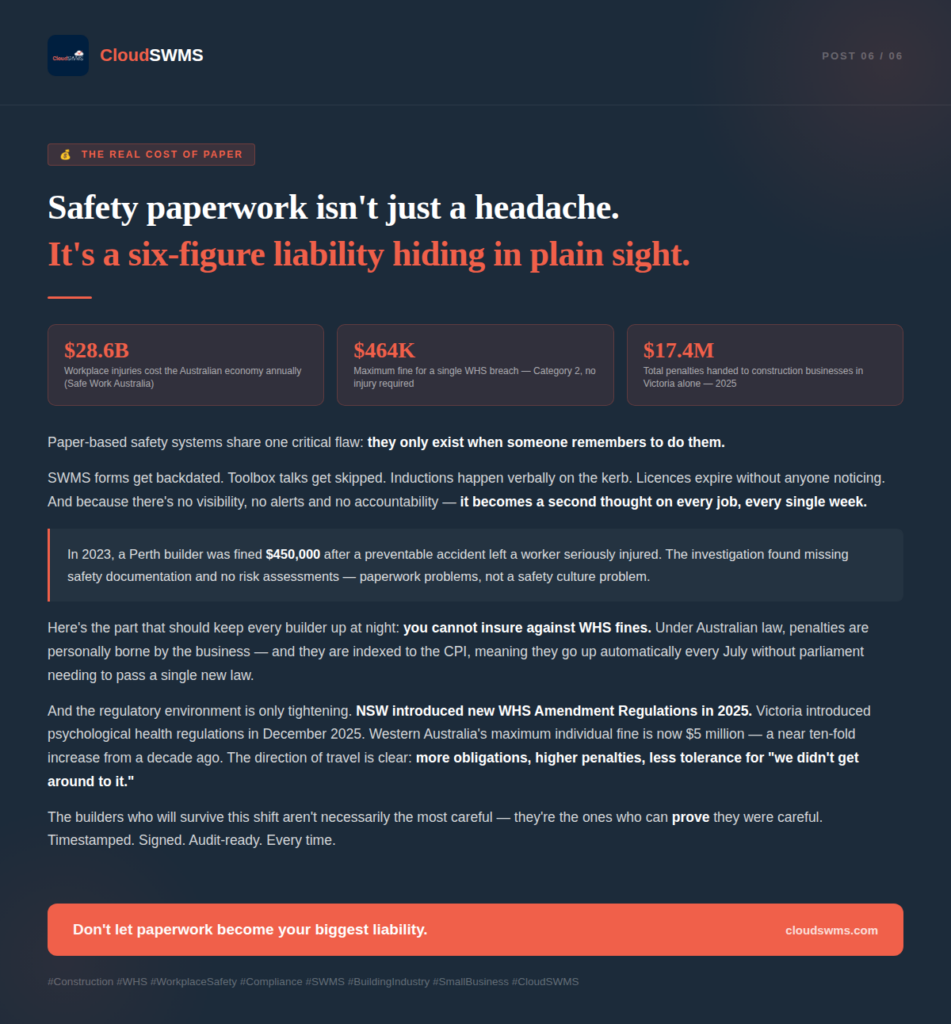
Workplace injuries cost the Australian economy $28.6B annually (Safe Work Australia). The maximum fine for a single WHS breach — Category 2, no injury required — is $464K. In Victoria alone, $17.4M in total penalties were handed to construction businesses in 2025.
Paper-based safety systems share one critical flaw: they only exist when someone remembers to do them.
SWMS forms get backdated. Toolbox talks get skipped. Inductions happen verbally on the kerb. Licences expire without anyone noticing. And because there’s no visibility, no alerts and no accountability — it becomes a second thought on every job, every single week.
In 2023, a Perth builder was fined $450,000 after a preventable accident left a worker seriously injured. The investigation found missing safety documentation and no risk assessments — paperwork problems, not a safety culture problem.
Here’s the part that should keep every builder up at night: you cannot insure against WHS fines. Under Australian law, penalties are personally borne by the business — and they are indexed to the CPI, meaning they go up automatically every July without parliament needing to pass a single new law.
And the regulatory environment is only tightening. NSW introduced new WHS Amendment Regulations in 2025. Victoria introduced psychological health regulations in December 2025. Western Australia’s maximum individual fine is now $5 million — a near ten-fold increase from a decade ago. The direction of travel is clear: more obligations, higher penalties, less tolerance for “we didn’t get around to it.”
The builders who will survive this shift aren’t necessarily the most careful — they’re the ones who can prove they were careful. Timestamped. Signed. Audit-ready. Every time.